The Localization Code for Cross-Border Marketing: The Art of Genuine Camouflage from IP to Behavior
Have you ever felt perplexed when, despite a substantial budget, your advertising efforts in overseas markets fall far short of expectations? After content publication, there's little engagement, or your accounts are frequently subjected to risk control limitations. Behind this often lies not a problem with your creativity or products, but a more fundamental yet crucial aspect—the "localization" of your digital identity in the target market has revealed your true origins. For marketers engaged in cross-border expansion, achieving true localized marketing has long surpassed mere language translation and holiday posters; it begins with the IP address of every account login and permeates every seemingly minor user behavior.
When "Pseudo-Localization" Becomes the Biggest Bottleneck for Growth
In today's increasingly competitive global landscape, brands expanding overseas have become an inevitable choice for many enterprises. Whether you are an independent website seller, an app developer, or a brand agency, you are eager to establish deep connections with overseas users on social platforms like Facebook and Instagram. Precise localized marketing is not only a powerful tool for increasing conversion rates but also the cornerstone for reducing customer acquisition costs and building brand trust.
However, the reality is stark and painful. Many teams adopt the practice of using a generic proxy located in a data center to manage accounts targeting multiple markets such as the US, Germany, and Japan. From the perspective of platform algorithms, this behavior pattern is extremely unnatural—an account's IP address might jump from Tokyo to Berlin within minutes, yet the content posted attempts to resonate with the local community. This disconnect not only leads to a significant reduction in organic recommendation traffic for content but also triggers the platform's security mechanisms. At best, it results in feature restrictions; at worst, it leads to direct account suspension, rendering years of operational efforts in vain.
The Dual Traps of Generic Proxies and Manual Management
Faced with the aforementioned problems, common solutions have significant limitations:
- The "Geographic Confusion" Risk of a Single Proxy: Using a fixed or dynamic but geographically indiscriminate proxy to manage all accounts is the most common and dangerous practice. It directly signals to the platform that the operation is unconventional, making it a primary suspect for account association and risk control.
- The Inefficiency and Chaos of Manual Proxy Switching: Some teams that recognize the importance of IP purchase individual static residential IPs or proxy services for accounts in different countries. However, the management process is a nightmare: it requires manually configuring, recording, and switching proxies for each browser. With many accounts, errors are highly likely. Not to mention, when operating multiple accounts simultaneously for bulk posting or interaction, manual operation is almost impossible.
- "Local IP" Alone Is Far From Enough: Even if the IP's geographic issue is resolved, if the account's behavioral fingerprint—such as browser environment, login time patterns, and operation rhythm—continues to adhere to a "China time zone" intensive operation mode, it will still be identified as abnormal by the platform's advanced detection systems.
These methods either sacrifice account security or operational efficiency, making it difficult for the localized marketing strategy to truly land at the execution level.
Deconstructing "Localization": A Systems Thinking Approach from Infrastructure to Behavioral Patterns
To achieve true account localization, we must establish a layered thinking framework:
- Network Layer Localization: This is the fundamental basis. The IP address used by the account must be a native local proxy from the target country or region, preferably a residential IP from a real home broadband connection, ensuring IP cleanliness and low abuse rates.
- Environment Layer Isolation: Each account must run in a completely independent browser environment, with its own Cookies, cache, local storage, and browser fingerprint. This effectively prevents account association caused by data breaches.
- Operation Layer Simulation: The account's daily operations (login, browsing, posting, interaction) need to simulate the rhythm and habits of real users, avoiding programmatic and repetitive bulk operations.
- Scalable Management Efficiency: While fulfilling the above three points, the solution must support teams in managing dozens or even hundreds of accounts at scale, rather than increasing the human workload.
This line of thinking clearly leads to a conclusion: we need a central platform that can unify and coordinate "local network environments" and "simulated behavior management."
Building an Efficient Localization Workflow: The Synergy of FBMM and IPOcto
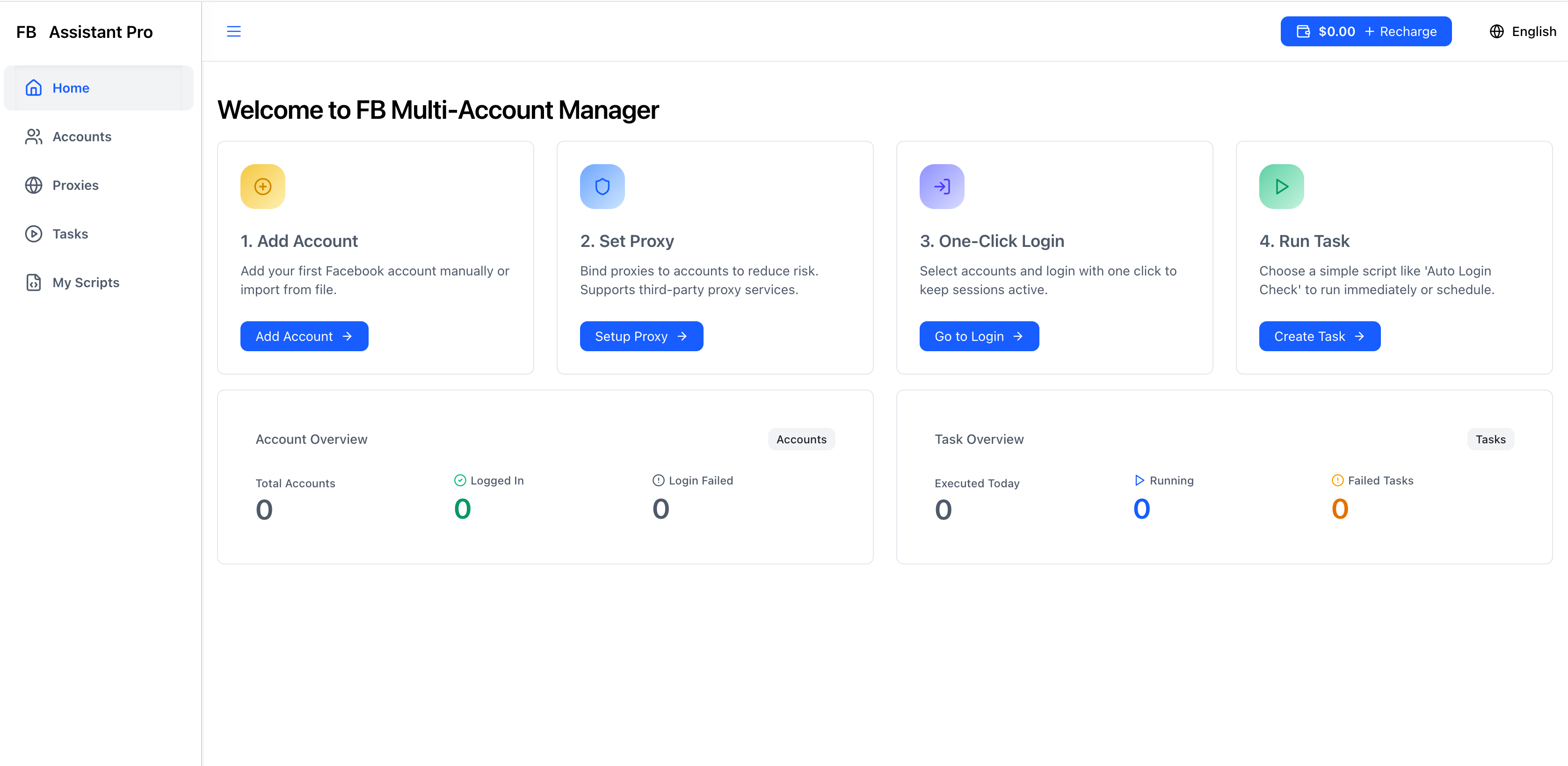
In practice, professional teams combine network proxy services with account management tools to form an efficient workflow. Here, we use the synergy of FB Multi Manager (FBMM) and IPOcto Global Proxy as an example to demonstrate how the above thinking can be implemented.
FBMM itself does not provide proxies, but it is a powerful Facebook multi-account management platform. Its core value lies in providing an independent browser environment with multi-account isolation for each Facebook account and enabling safe and efficient bulk control tasks. IPOcto, on the other hand, specializes in providing high-quality native local proxies from various regions worldwide.
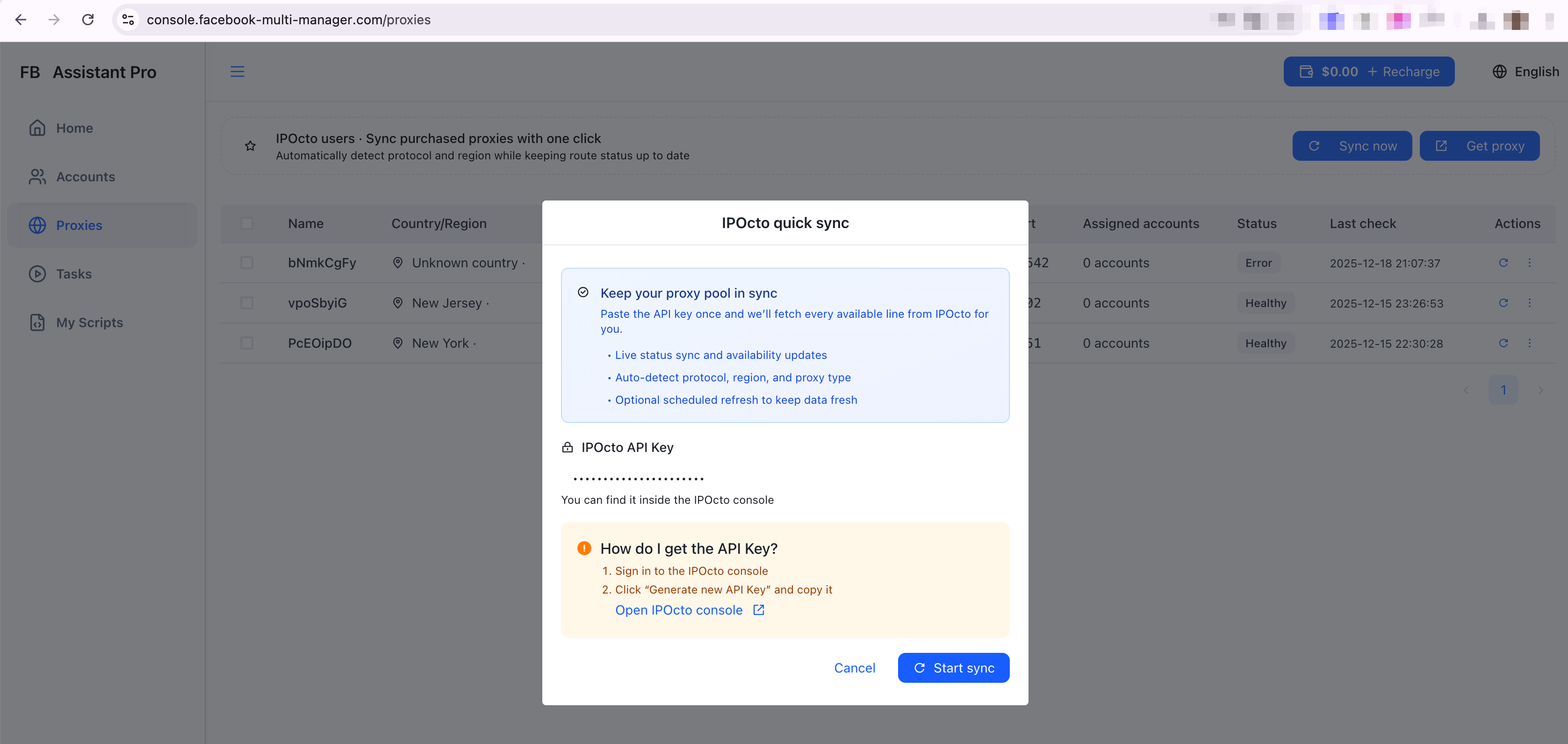
The logic of their collaboration is as follows: marketing personnel, based on business needs, select and obtain proxy IPs from the target country (e.g., USA, Germany, Japan, Southeast Asian countries) from the IPOcto backend. Then, through a convenient one-click synchronization function, these proxy configurations are imported into the FBMM platform. Finally, within FBMM, operators can clearly and accurately assign the corresponding US IP to the US market account, the German IP to the German market account, and so on, like assigning tasks, achieving precise matching of IP addresses and accounts.
| Operation Step | Tool/Platform | Value Achieved |
|---|---|---|
| Obtain Target Country Local IP | IPOcto and other proxy service providers | Lays the foundation for network layer localization, obtaining real residential IPs. |
| Centralized Import and Management of Proxies | FBMM Proxy Configuration Module | Centralizes scattered proxy resources, avoiding chaos. |
| Assign Exclusive IP to Account | FBMM Account Management Interface | Achieves fixed, precise binding of accounts to local IPs, ensuring a consistent login environment each time. |
| Execute Operations in Isolated Environment | FBMM Virtual Browser Environment | Provides an independent anti-association browser, isolates account data, and simulates a real device. |
| Perform Bulk Localized Operations | FBMM Batch Task Function | Efficiently completes cross-account posting, interaction, and other tasks while ensuring IP and environment localization. |
The key to this process is that FBMM acts as the "command center." It allows high-quality local proxy resources to be systematically and error-free applied to each specific account, and on this secure foundation, it unleashes the team's productivity.
A Cross-Border E-commerce Team's Wednesday Morning: From Chaos to Seamless Flow
Let's imagine a scenario. A cross-border home goods brand simultaneously operates independent websites in the US, Germany, and Japan, and corresponds to managing Facebook pages and ad accounts in these three regions.
Past (Manual Management Era):
- At 9 AM, Operations Assistant Wang needs to post a new product. He first opens his browser extension, switches to a US proxy, logs into the US account, and completes the post.
- Subsequently, he needs to clear browser data, switch to a German proxy, log into the German account, and repeat the operation. During this process, login anomalies might occur due to incomplete cache clearing or unstable proxy connections.
- By the time he operates the Japanese account, it's already nearing noon. Throughout the morning, he has been engaged in repetitive mechanical labor of logging in, posting, and logging out, all while constantly worrying about account security.
Present (FBMM + IPOcto Collaborative Workflow):
- Wang has pre-configured fixed IPs for the US, Germany, and Japan (from IPOcto) in FBMM and bound them to the three respective accounts.
- On Wednesday morning, he directly opens three independent browser windows in the FBMM console. Each window's account is automatically in the correct local IP environment.
- He uses the bulk posting feature to simultaneously post localized copy and images to the three pages. The entire process is completed within 10 minutes, and each account's posting behavior resembles that of a local user operating normally.
- The time saved can be used to analyze interaction data in various markets and optimize advertising strategies, truly engaging in creative marketing work.
This transformation essentially liberates operators from arduous, high-risk technical labor, allowing them to focus more on content, creativity, and strategy itself, which is the fundamental way to improve marketing efficiency.
Conclusion
The success of cross-border expansion increasingly relies on meticulous attention to detail. Localized marketing is by no means just a slogan; it requires careful design starting from the account's "digital birthplace." By combining the native local proxies provided by IPOcto Global Proxy with the multi-account isolation and bulk automation management capabilities of FBMM, marketing teams can build a localized operational system that is both safe, compliant, and efficiently scalable.
This is not just a means of risk avoidance but a strategic investment to proactively win platform algorithm recommendations and build genuine trust with local users. When every one of your accounts can think and act like a true "local resident," traffic and growth will naturally follow.
Frequently Asked Questions FAQ
Q1: I'm already using a proxy, why is my Facebook account still restricted? A: There can be multiple reasons: 1) You may be using data center IPs or IPs that have been abused, not pure native local proxies; 2) Multiple accounts share the same browser environment or IP, leading to account association; 3) Account operational behavior (e.g., posting frequency, interaction patterns) does not conform to real human habits. It is recommended to systematically check from the three dimensions of network purity, environment isolation, and behavioral simulation.
Q2: How can I manage multi-country accounts for different social media platforms (e.g., FB, Instagram, TikTok)? A: The core logic is the same: each account needs to be equipped with local IPs from the target country and an isolated environment. Professional multi-account management platforms (such as FB Multi Manager) usually support managing accounts for multiple social platforms within the same platform, and uniformly performing proxy configurations and environment isolation, which is much more efficient than using different tools for each platform.
Q3: Can using local IPs and management tools guarantee 100% account security? A: No tool can guarantee 100% security, as platform risk control strategies are constantly evolving. However, adopting a combination of "native local IP + isolated environment + simulated operations" can greatly reduce risks and raise account security to the level of industry best practices. This is equivalent to providing your accounts with the most robust "basic immune system."
Q4: For startup teams or budget-constrained enterprises, how can they start implementing this localization strategy? A: It is recommended to start with the most core markets and proceed step by step. For example, if the US is the main market, you can first configure reliable US residential IPs for accounts targeting this market and use management tools with environment isolation capabilities for operations. After seeing improvements in results and efficiency, replicate this model to other markets. Investing in the right infrastructure upfront is much more economical than dealing with the losses from account suspensions later.
📤 Share This Article
🎯 Ready to Get Started?
Join thousands of marketers - start boosting your Facebook marketing today
🚀 Get Started Now - Free Tips Available