Why is “Centralized Management” Capability the Lifeline for Advertising Agencies in the Next Three Years?
In the cross-border e-commerce and overseas marketing industry, a consensus is forming: the era of traffic dividends has long ended, and we have entered a hardcore era of competing in “refined operations” and “cost reduction and efficiency improvement.” For advertising agencies and marketing teams, relying on increasing headcount and stacking accounts to expand scale is becoming increasingly difficult and fraught with risk. Profits are constantly squeezed, while platform rules become more stringent. Against this backdrop, a core capability is transitioning from a “bonus point” to a “survival necessity” – the ability to centrally manage a massive number of Facebook ad accounts. This is not merely a tool upgrade; it is a revolution in mindset concerning efficiency, security, and sustainable growth.
When Growth Hits a Bottleneck: The Common Predicament of Advertising Agencies
If you run an advertising agency or manage a cross-border marketing team, you'll likely find the following scenarios all too familiar:
- Out-of-Control Labor Costs: For every new client or market added, it seems a new operational personnel is needed to manage the corresponding ad account. The team size inflates, but per capita output and profit margins decline.
- Skyrocketing Operational Risks: Team members use their own computers and network environments to operate different accounts. An inadvertent operational error (e.g., IP confusion, duplicate creatives) could lead to a Facebook account being banned, affecting the progress of the entire client's project, with immeasurable losses.
- Difficulty in Improving Efficiency: Repetitive tasks fill the daily routine: switching logins between different accounts, setting similar ad parameters for multiple campaigns, manually downloading and integrating performance data reports from various accounts. These trivial matters consume a significant portion of the team's creative time.
- Ambiguous Asset Status: It's difficult to keep real-time track of how many healthy ad accounts are available, their respective budgets, historical performance, and associated risks. The status of these digital assets is like a black box, making effective planning and allocation impossible.
Behind these pain points lies a fundamental contradiction: the business requires multi-account, multi-threaded operations to cover more markets and clients, but the traditional decentralized, manual management model has hit its ceiling in terms of cost, risk, and efficiency.
Why Do Traditional “Human Sea Tactics” and Fragmented Tools Fail?
Facing the aforementioned difficulties, there are two common approaches, both with significant limitations.
1. Continue Increasing Manpower (Human Sea Tactics) This seems like the most direct solution. However, the problem is that labor costs grow linearly, while management complexity increases exponentially. Once the number of accounts exceeds a certain threshold, the management chaos, communication costs, and probability of errors brought by new hires will far outweigh the value they provide. More importantly, risk control systems of platforms like Facebook precisely flag abnormal human operational patterns (e.g., batch operations at fixed times, frequent IP switching), and increasing manpower could ironically increase the risk of account association and banning.
2. Use Fragmented Automation Scripts or Plugins There are some single-function scripts or tools on the market, such as automatic posting, bulk liking, etc. The drawbacks of these solutions are:
- Questionable Security: Many tools require you to grant extremely high account permissions, and it's impossible to know if their code is secure or if it will steal data.
- Fragmented Functionality: You need to combine multiple tools to complete different tasks like login isolation, batch operations, and data aggregation, leading to a fragmented workflow and high maintenance costs.
- Lack of Anti-Ban Mechanisms: They often only solve the “automation” problem, neglecting the most crucial needs for “account security” and “environment isolation.” Without real browser fingerprint simulation and independent cache environments, using these tools is akin to “running naked” under the platform's risk control system.
| Traditional Method | Core Problem | Potential Risks |
|---|---|---|
| Increasing Manpower | Linear cost growth, obvious efficiency bottleneck | Inconsistent operations, frequent human errors, easily triggers platform risk control |
| Fragmented Tools/Scripts | Single functionality, lack of integration, unknown security | High risk of account information leakage, cannot solve environment association, prone to batch account bans |
These methods only address the symptoms, not the root cause, because they don't touch upon the core issue: how to upgrade the decentralized, fragile “human-driven” account management model to a unified, stable “technology-driven digital asset” management model.
From “Managing Accounts” to “Operating Assets”: A Shift in Mindset
To break through the predicament, a cognitive upgrade is needed first. We should no longer view each Facebook ad account as an independent tool that requires “manual maintenance,” but rather as an important “digital asset” of the company. Like any asset, it needs to be clearly inventoried, securely stored, efficiently deployed, and capable of generating stable returns.
This shift gives rise to several key judgment criteria:
- Security is the Bottom Line: Assets cannot be lost. Reliable anti-association mechanisms must be established to ensure that problems with a single account do not affect other assets.
- Visibility is Fundamental: You must be able to grasp the status, performance, and history of all assets at a glance to make informed decisions.
- Operational Efficiency is Competitiveness: Daily maintenance and deployment operations for assets must be highly automated, freeing up manpower from repetitive labor to focus on higher-value work such as strategy optimization and client communication.
- Scalability is the Future: The asset management system must be able to easily cope with business growth, smoothly supporting an increase in account numbers without having to reconfigure the entire workflow.
Based on these criteria, an ideal solution would be a centralized management platform that can provide an independent, secure operating environment for each ad account, along with a unified control center to execute all operations.
Building a Centralized Management System: How Platforms Provide Support
Within this framework, the value of professional tools becomes evident. Platforms like fbmm are not simply automation tools, but infrastructure built for multi-account management scenarios. Their core value lies in providing the technical path for the aforementioned mindset shift:
- Achieve True Asset Isolation and Security: By assigning an independent virtual browser environment (including independent Cookies, cache, local storage, and even fingerprint information) to each Facebook account, account association risks due to identical IPs or browser fingerprints are fundamentally eliminated. This is equivalent to equipping each digital asset with an independent “safe box.”
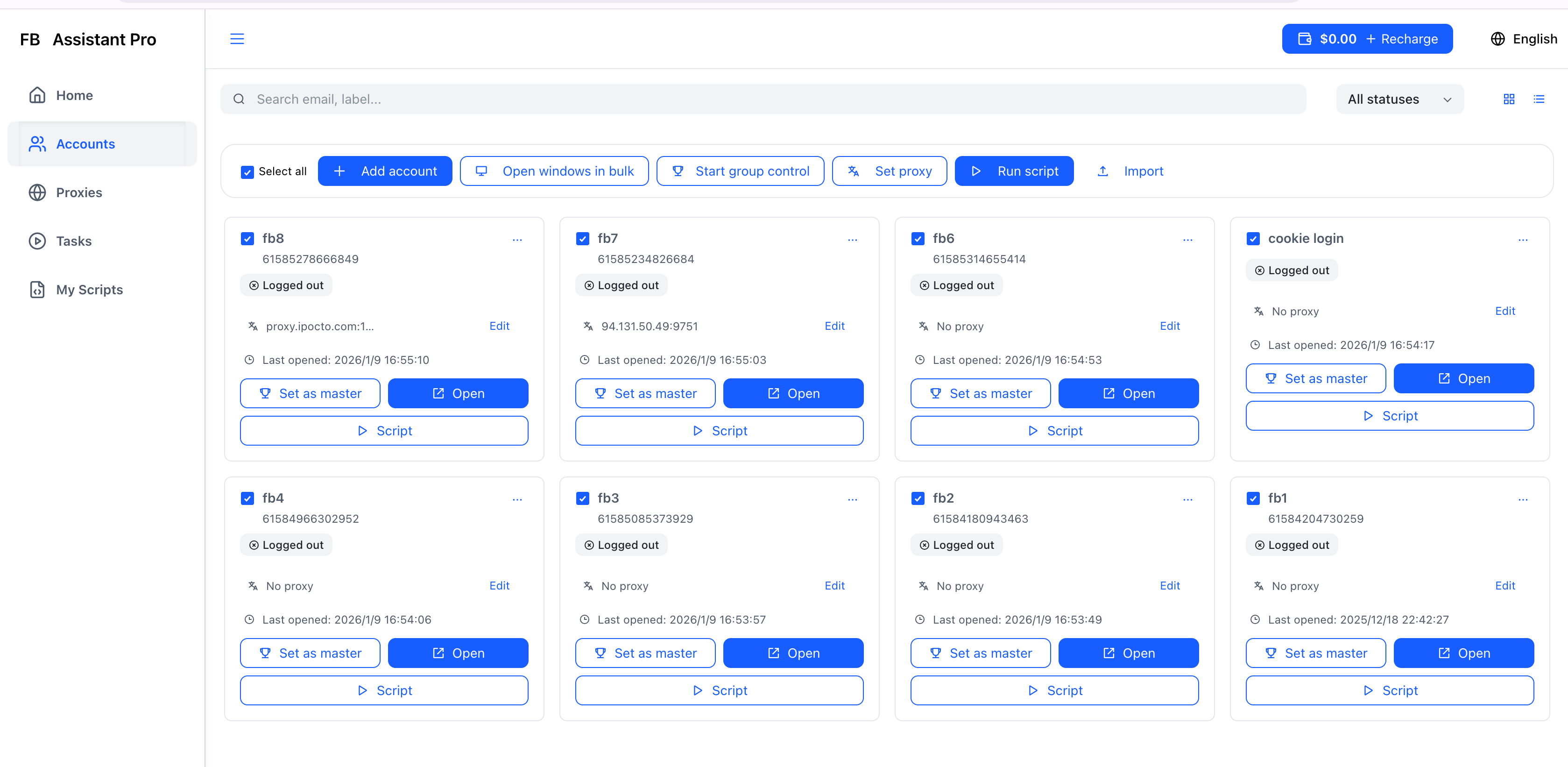
- Provide a Unified Command and Control Center: All managed accounts can be clearly displayed on a single dashboard. Operators no longer need to memorize countless account passwords or switch between multiple browser tabs. Batch operations (such as creating similar ad campaigns for multiple accounts simultaneously, publishing posts uniformly, and responding to messages centrally) become as simple as operating a single account, greatly improving team collaboration efficiency.
- Integrate Compliant Operations into the Workflow: The platform's design inherently adheres to the operating norms of mainstream social media platforms. By simulating real human operation intervals and managing the lifecycle of login sessions, it reduces the risk of automated operations being too “mechanical” and violating platform rules, while enhancing efficiency.
A Day's Workflow Comparison: From Chaos to Order
Let's see how a centralized management platform can reshape the workflow through a typical day for an advertising agency operator, "Xiao Chen."
Past (Decentralized Management):
- 9:00 AM: Open an Excel spreadsheet to find the information for the 15 ad accounts corresponding to the 5 clients that need to be checked today.
- 9:30 AM: Use incognito mode or different browsers to manually log in to accounts A, B, C... one by one. Each login requires entering verification codes, checking data, and taking screenshots.
- 11:00 AM: Notice abnormal ad spending on client X's account and need to adjust the budget. Log in to that account again to make the adjustment.
- 2:00 PM: Receive a task to publish warm-up posts for new product launches for 3 different clients. Repeat the login, edit, and publish process 3 times.
- 4:00 PM: Manually aggregate key data (spending, conversions, ROI) for the day from the 15 accounts into another Excel report.
- Before End of Workday: Worried about forgetting to log out of an account, or that the login environment changes tomorrow will lead to a ban, anxiously check everything.
Present (Using a Centralized Management Platform):
- 9:00 AM: Log in to the fbmm unified console. The status and yesterday's key data overview for all managed accounts are clear at a glance.
- 9:15 AM: Notice abnormal spending on client X's account. Click to switch to that account environment directly within the console, quickly adjust the budget, and save.
- 10:00 AM: Use the "Batch Publish" function. Select 3 target accounts at once, edit a warm-up post, set the publishing time, and submit with one click. The system will automatically publish according to the schedule in their respective isolated environments.
- 10:30 AM: Use the built-in data dashboard or report export function to generate standardized data reports for all accounts with one click and send them to the team leader.
- Afternoon: Use the saved time to analyze ad performance trends, optimize audience targeting, and communicate strategies with clients.
This transformation brings not only time savings but also improvements in work quality, risk reduction, and redefinition of team value.
Conclusion
In today's era of shrinking industry profits and white-hot competition, the competition among advertising agencies has deepened from a pure competition for "client resources" to a competition in “operational efficiency” and “risk management capabilities.” The extensive model relying solely on manpower growth has reached its end.
Upgrading Facebook multi-account management from a “handicraft” dependent on individual experience to a platform-based, replicable “digital asset operation system” is a crucial step towards building core competitiveness for the future. Centralized management is not just a tool for managing multiple accounts; it is the underlying architecture that ensures business security, stability, and scalable growth. It allows teams to respond more calmly to changes in platform rules, serve clients more efficiently, and ultimately achieve greater profit margins in a market with limited growth. While 2026 may not be here yet, the window of opportunity to build this capability is now.
Frequently Asked Questions FAQ
Q1: Will centralized management platforms be considered a violation tool by Facebook official? A: The key lies in the platform's behavior patterns. The core of a professional multi-account management platform (like fbmm) is to provide secure environment isolation and compliant efficiency operations (such as reasonable operation intervals). Its purpose is to help users manage their own assets more securely and规范. It is fundamentally different from abusing automation scripts for cheating. It is crucial to choose tools that are transparent, focus on simulating real human behavior, and respect platform terms.
Q2: Our company has few accounts (less than 10), do we still need such a platform? A: Even with a small number of accounts, the value of centralized management still exists. It mainly lies in: first, risk prevention, establishing good operating habits and isolated environments to lay a secure foundation for future business expansion; second, improving efficiency, reducing time spent on repeated logins and data aggregation; third, standardizing processes, making team operations standardized and avoiding operational confusion due to personnel changes. It is the beginning of professional management of "account assets."
Q3: How can we ensure the security of our account data and privacy when using such platforms? A: When choosing a platform, special attention must be paid to its security design. Reliable platforms should have: 1) Encrypted data transmission and storage; 2) A clear privacy policy stating that your social media account passwords and sensitive data will not be stored; 3) Independent browser environment isolation technology to ensure that data is not leaked between accounts. It is recommended to thoroughly understand the security white paper or related documentation before making a choice.
Q4: Is the migration process of existing accounts to the management platform complex? Will it affect ongoing ad campaigns? A: Professional platforms will provide a smooth migration solution. The process is usually: create a new, independent isolated environment for each existing account within the platform, and then log in to the account once in that environment (this may require verification). This process itself does not interfere with the normal status of the account in the original browser or ongoing ad campaigns. After migration, all subsequent operations will be performed through the new environment, achieving a seamless switch.
📤 Share This Article
🎯 Ready to Get Started?
Join thousands of marketers - start boosting your Facebook marketing today
🚀 Get Started Now - Free Tips Available