Goodbye Account Linking: Why the Integration of Static ISP Proxies and Efficient Management Tools is the Cornerstone of Matrix Operations?
In the world of cross-border e-commerce, social media marketing, and digital advertising agencies, one word is enough to keep operators tossing and turning at night: account linking. Facebook's risk control system is like a precise and strict referee, and any suspicious login behavior can trigger an alarm. For teams that rely on multi-account matrices for large-scale operations, this is not just a question of efficiency, but a matter of survival. We often spend a lot of effort on content creation and ad optimization, only to fail at the most basic login environment.
The Realistic Dilemma of Matrix Account Operations: We're Walking a Tightrope Every Day
Imagine this scenario: You manage dozens or even hundreds of Facebook accounts for customer service, content distribution, ad testing, or market segmentation. Each account represents an independent business line or market entry point. However, no matter how careful you are, you'll always encounter some baffling "accidents": an account that has just been nurtured is suddenly required to verify, a set of meticulously planned ad accounts is disabled simultaneously, even though the content and operational behavior appear unrelated.
The core issue behind this often traces back to the most fundamental layer: the network environment. Facebook's risk control algorithms use a large number of signals to determine the association between accounts, with IP addresses, browser fingerprints, and device information being the most critical dimensions. When multiple accounts frequently log in from the same IP address, or when the IP type and geographical location experience abnormal jumps, the system easily classifies it as "unnatural operation" or "fake account."
For globalized operations teams, using proxy servers to manage accounts in different regions has become an industry norm. However, it is precisely this "norm" that has become the biggest source of risk for many teams.
The Pitfalls of Datacenter Proxies: Why Your Proxies Might Be "Betraying" You?
Currently, the most common type of proxy on the market is datacenter proxy. They are cheap and easy to obtain, making them the preferred choice for many beginners. However, for platforms like Facebook, datacenter proxies are precisely one of the highest risk signals.
The reason is simple: real individual users rarely access social media through the IP addresses of large data centers. These IP address ranges are public and have long been marked and monitored by major platforms. When you use a well-known datacenter proxy IP to log in, it's no different than holding up a sign that says "I am using a proxy" in Facebook's eyes. What's worse is that these proxy IPs are usually shared, meaning hundreds or thousands of users may take turns using the same IP. This means your account not only exposes itself to using a proxy, but it might also be "punished by association" due to the illegal operations of other users.
This shared, dynamic, and high-risk IP environment is one of the primary reasons for mass account linking and bans. It turns matrix operations into a pure game of chance.
From "Hiding" to "Simulating": A Shift in Thinking to Build Trusted Digital Identities
Facing the risk of proxy linking, the industry's early approach was "hiding": trying to erase traces by constantly changing IP addresses and clearing cookies. However, this method is not only inefficient but also ineffective. Platform risk control is constantly evolving, and simple "hiding" is increasingly easy to detect.
A more sensible approach should be to shift from "simulating reality" to "building reality." What we need is not a constantly changing disguise, but a stable, trustworthy, and unique digital identity. For Facebook accounts, one of the core components of this identity is a clean, static, residential IP address.
This leads to another key choice in the proxy domain: ISP proxies. ISP proxy IPs originate from real Internet Service Providers (such as Comcast, AT&T, Verizon, etc.) and share the same source as IPs used by ordinary home users. These IPs have extremely high trust, as they simulate the most realistic user network environment. Among them, static/fixed ISP proxies have particular value: they provide a long-term, exclusive IP address from a real residential area for each of your Facebook accounts. This IP is like the account's "digital ID card," fixed and highly credible.
The Value of Tools: Achieving Large-Scale Operations in a Deterministic Environment
After understanding the importance of static ISP proxies, the next challenge is operational: how to efficiently, accurately, and securely assign hundreds of static IPs to the corresponding hundreds of Facebook accounts? And how to ensure that each account can consistently use its "exclusive ID card" for subsequent daily logins, posting, and interactions?
Manually configuring browsers, recording IPs, and managing passwords is completely unfeasible for matrix scale. At this point, the value of a professional multi-account management platform becomes prominent. It is not a "black technology" cracking tool, but a workflow hub that enhances operational determinism, reduces human error, and achieves scale efficiency under safe and compliant conditions.
Taking Facebook Multi Manager, which I use, as an example, its core value lies in providing a centralized operating interface and a stable automated execution environment. But more importantly, it deeply understands that "environmental isolation" is the foundation of security. Each account operates in a completely independent virtual environment within the tool, with its own browser fingerprint, cache, and cookies. This provides the perfect underlying architecture for IP "one account per IP" usage.
Key Workflow: Precisely Binding Static IPs with Accounts
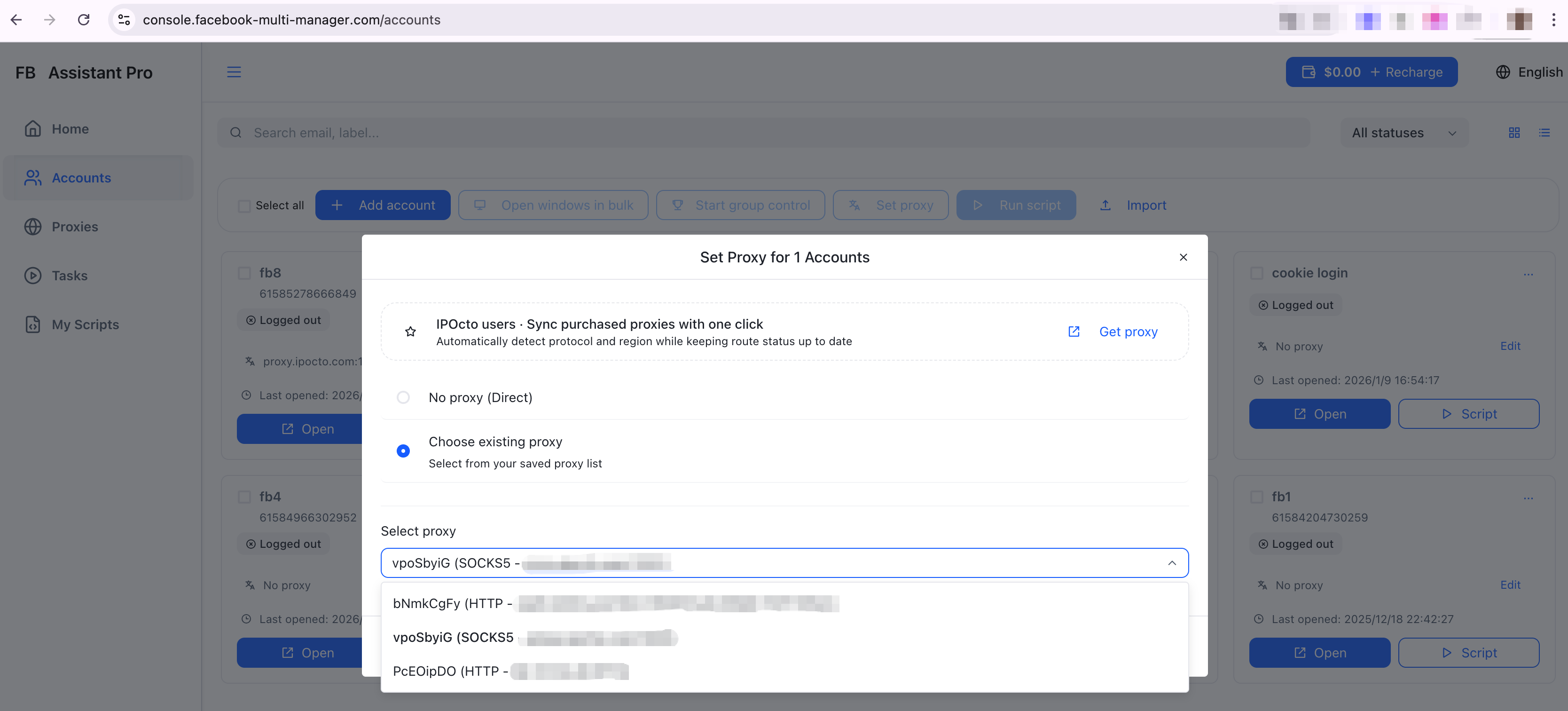
The platform itself does not provide or allocate IPs, which is to ensure the independence of the proxy service and user choice. However, it provides extremely convenient integration channels. For example, you can one-click synchronize your purchased IPOcto static ISP proxies to the management backend.
The subsequent process is clear and rigorous:
- Synchronize Proxy Pool: In the FBMM proxy management page, import your list of static ISP proxies (including IP, port, username, and password).
- IP Quality Detection: Use the platform's built-in detection tools to quickly verify the availability, speed, and anonymity of this batch of proxy IPs. This step ensures that the "ID card" itself is valid and clean.
- Manual Precise Allocation: In the account management list, you can manually select and bind a static ISP proxy to each Facebook account. This binding relationship, once established, will remain effective.
- Isolated Environment Operation: Henceforth, all automated or manual operations for this account will be sent through this exclusive static residential IP. Since each account's environment is completely isolated, IPs will not be mixed, and behavioral fingerprints will not interfere with each other.
This process transforms "using static ISP proxies" from a complex technical concept into a standard operating procedure that can be executed in batches and managed visually.
A Real-Life Scenario: From Trepidation to Confident Deployment
Let's compare two scenarios:
Past (Using Shared Datacenter Proxies): Xiao Zhang's cross-border e-commerce team has 50 Facebook accounts for promotion on different vertical sites. They use a shared proxy pool with random IP allocation. Every week, 2-3 accounts are temporarily restricted due to "suspicious activity," and the team constantly has to appeal and verify, with ad campaigns frequently interrupted. They are always in anxiety, "not knowing who will be next."
Now (Integrating Static ISP Proxies and FBMM):
- Xiao Zhang's team purchased 50 static ISP proxies from different states in the US.
- They one-click synchronized these 50 proxies to the Facebook Multi Manager backend and completed quality detection.
- They manually bound these 50 proxy IPs one-to-one to the 50 Facebook accounts. Each account received its "exclusive ID card."
- Through the platform's batch management function, they can simultaneously perform account nurturing activities (such as browsing, liking), schedule post releases, or respond to messages for all accounts.
- Because each account's IP is static and residential, the login pattern is stable, and the probability of Facebook systems deeming it "normal user behavior" significantly increases. The account survivability and stability are greatly improved, allowing the team to focus entirely on content and marketing strategies.
| Comparison Dimension | Traditional Shared Datacenter Proxies + Manual Management | Static ISP Proxies + FBMM Integration |
|---|---|---|
| IP Trustworthiness | Extremely low, easily flagged by platforms | High, originates from real home broadband |
| Environmental Stability | Poor, IP dynamic changes, prone to linking | Excellent, IP is fixed and dedicated to each account |
| Operational Efficiency | Low, manual switching, prone to errors | High, batch binding, automated execution |
| Account Security Risk | High, high risk of mass linking | Low, effective isolation, simulates real users |
| Long-Term Operational Cost | High hidden costs (account bans, appeal time) | Predictable, focuses on business growth |
Conclusion: Security is the Foundation of Large-Scale Operations
In today's increasingly stringent platform rules, the success of matrix operations no longer depends on who possesses more "tricks," but on who respects platform rules more and simulates real user behavior in a more professional and credible manner. Saying goodbye to account linking doesn't start with complex scripts or expensive tools, but with building a trustworthy, stable, and independent network identity for each account.
Static ISP proxies provide the "cornerstone" of this identity, while professional multi-account management tools provide the "construction blueprints" to solidly embed this cornerstone into the operational workflow of each account. The combination of the two is not a simple feature overlay, but a complete operational philosophy and practice framework centered on security and determinism. It liberates operators from the "cat and mouse game" with risk control systems, allowing them to focus on true value creation: communicating with users, outputting high-quality content, and achieving business goals.
Frequently Asked Questions FAQ
Q1: What is the difference between static ISP proxies and dynamic residential proxies? Which is more suitable for Facebook multi-account management? A1: Dynamic residential proxy IPs change periodically. Although they also come from real homes, their variability is not conducive to long-term account stability. Static ISP proxy IPs are fixed and do not change, which is more in line with the scenario of a real user consistently using the same home broadband for internet access. For Facebook accounts that require long-term maintenance and weight building, static IPs are a safer and more realistic choice.
Q2: I'm already using proxies, why are my accounts still linked? A2: It's very likely that you are using shared datacenter proxies. These IPs are already heavily monitored by platforms and are shared by many users, making account linking extremely easy. Even if you use residential proxies, if multiple accounts share or rotate the same IP, the system will still detect linking. The key is "dedicated use per account" and "high-credibility IPs."
Q3: Are tools like Facebook Multi Manager in violation of Facebook's policies? A3: Facebook prohibits fake identities, spam, abuse of automation, and other behaviors. Professional multi-account management tools themselves are efficiency tools that help you manage multiple legitimate accounts more securely and compliantly (e.g., managing multiple client pages, operating different brand accounts). Their core function is to provide environmental isolation and automated workflows, not "cracking" or "cheating." The key is how users use them, and they must comply with the platform's community guidelines.
Q4: How can I check if my proxy IP is clean and if it has been flagged by Facebook? A4: Some proxy service providers offer IP detection services. In the proxy management function of FBMM, there are also built-in simple IP detection tools that can check the proxy's connectivity, speed, and basic anonymity. The most direct testing method is to use a newly registered, unimportant test account to perform regular operations through the IP and observe for any abnormal notifications within a period of time.
Q5: Will configuring a static ISP proxy for each account be too expensive? A5: The cost of static ISP proxies is indeed higher than that of shared datacenter proxies. However, this is an investment mindset rather than a cost mindset. Compared to the loss of advertising budgets, customer resources, team time wasted due to account bans, and the opportunity cost of re-nurturing accounts, the investment in fixed high-quality proxies is worthwhile. It ensures business continuity and asset (account) security, and in the long run, it is a key step in reducing costs and increasing efficiency.
📤 Share This Article
🎯 Ready to Get Started?
Join thousands of marketers - start boosting your Facebook marketing today
🚀 Get Started Now - Free Tips Available