Human Costs Slashed by 70%: A Revolution in Facebook Account Management Efficiency for Overseas Teams
In the battlefield of cross-border e-commerce and overseas marketing, operations teams often find themselves in a dilemma: the market demands a matrixed account strategy to test content, diversify risks, and reach broader audiences. However, the reality is that the human resources required to manage these accounts are rapidly consuming already limited profit margins. I've personally witnessed a startup overseas team spend over 60% of their operational time on repetitive basic tasks like logging in, posting, and interacting, rather than on actual market strategy thinking.
Multi-Account Operation is the Standard, But Human Costs Are Unbearable
For any company aiming to establish a presence in the global market, a single social media account strategy is long outdated. Whether for A/B testing, localized content operation, managing sub-businesses of different brands, or simply circumventing platform risk control, operating multiple Facebook accounts has become the industry standard. However, the resulting management complexity grows exponentially.
An operations specialist can manually manage 5-10 accounts at their limit. They constantly need to switch browsers, log in to accounts, check feeds, publish content, and reply to comments. This is not only tedious and inefficient but also prone to errors – posting to the wrong account, forgetting to switch, or delayed interaction. Each small mistake can affect brand image or trigger platform review. When businesses need to scale to 50, 100, or even more accounts, the team size must expand accordingly, and human costs immediately become the heaviest burden in the financial model.
The Vicious Cycle of Manual Management and Primitive Tools
Faced with human bottlenecks, teams often react by "hiring more people." Recruiting more operations specialists, implementing double or even triple shifts to fill time gaps and task loads with manpower. This directly leads to uncontrolled operational costs. Another common practice is seeking "gray" browser plugins or scripts to achieve semi-automation. However, these methods often come with significant risks: account linking leading to mass bans, unstable tools causing data loss, and even permanent account loss due to policy violations.
More crucially, regardless of the method, it ties down the team's most valuable resource – human creativity and strategic thinking – to mechanical repetitive labor. Team members have no time to analyze data, optimize ads, or plan creative content, leading to the entire business growth engine getting stuck in a low-level, repetitive cycle.
From Cost Center to Efficiency Engine: The Inevitable Choice of Automated Management
When we realize the problem is not "not enough people" but "outdated methods," the solution becomes clear. The real breakthrough lies in elevating operations personnel from executors to managers and strategists. This means we must delegate repetitive, regular, and high-frequency underlying operations to reliable tools for automated execution.
An ideal solution should possess several core characteristics: first is security, ensuring that each account's login environment is absolutely independent to prevent linking from the source; second is stability, the tool itself needs to have enterprise-level reliability; and finally, powerful batch processing capabilities, capable of transforming operational actions from "single points" to "batches," unlocking significant time dividends. This is not just about purchasing a tool, but a strategic upgrade of the team's workflow and cost structure.
Taking FBMM as an Example: How Tools Reshape Operational Cost Structures
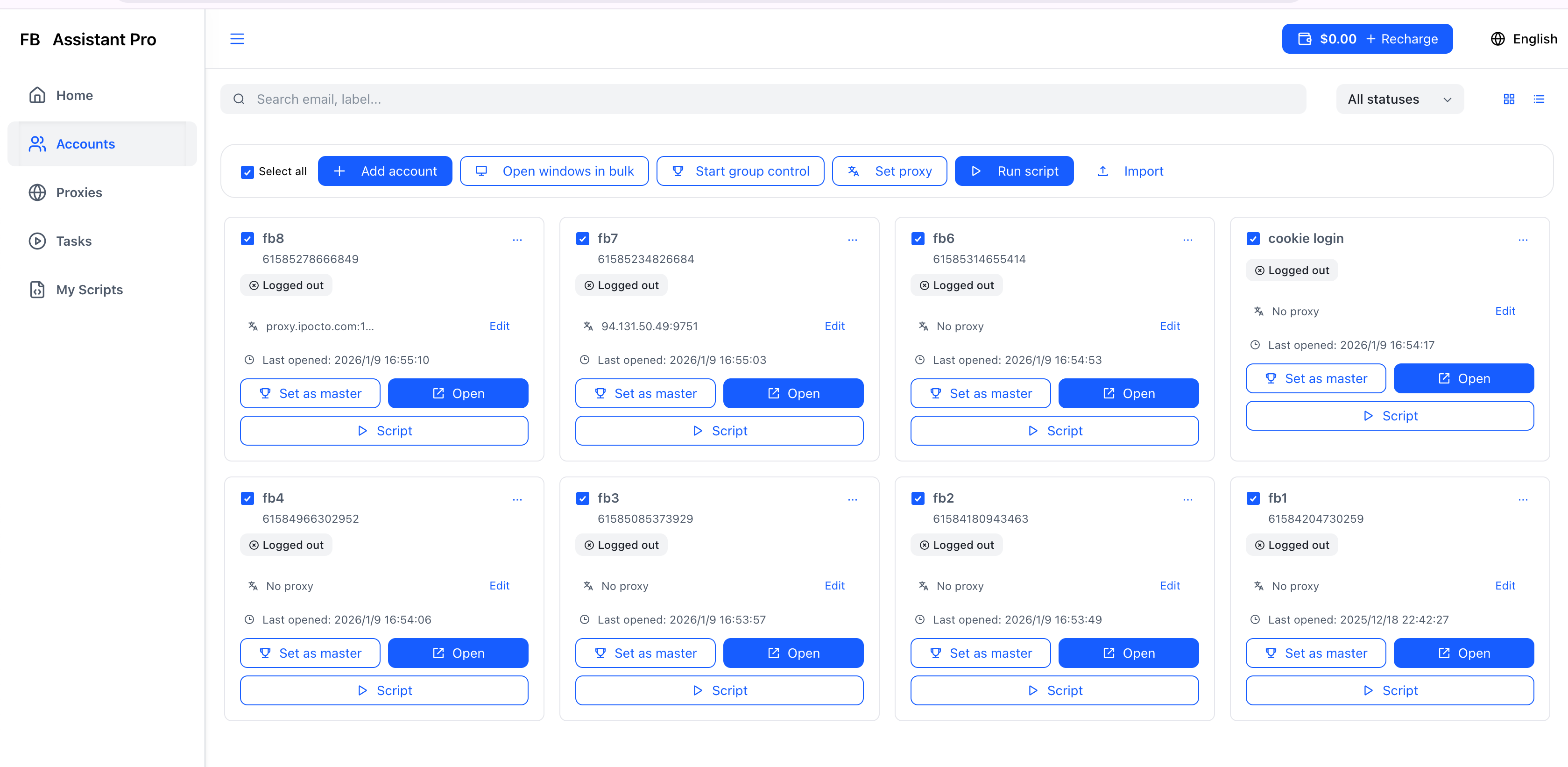
In this vein, the value of professional tools becomes prominent. Taking platforms like Facebook Multi Manager (FBMM) as an example, its core value is not to replace people, but to empower them. By providing a clean, independent browser environment, it simulates real, isolated login states for each Facebook account, which is the cornerstone of secure operation. On this foundation, its batch operation function becomes the leverage for changing cost structures.
Imagine operations that originally required logging into each account for posting, liking, commenting, and friend management, now can be selected on a console for hundreds of accounts and completed at once. This means the number of accounts an operations specialist can effectively manage and execute is no longer 5-10, but grows tenfold or even more. The tool takes over all repetitive labor, allowing the team to focus on higher-value tasks such as content strategy development, ad data analysis, and user interaction optimization.
Let's Do the Math: How Efficiency Gains Directly Translate to Profit
Let's make a direct comparison to see the financial impact of automated management tools.
Suppose a startup overseas team aims to conduct content testing and initial traffic acquisition in different markets.
| Operational Model | Number of Accounts Managed | Full-time Operations Staff Required | Primary Time Consumption | Estimated Weekly Work Hours | Human Cost Focus |
|---|---|---|---|---|---|
| Pure Manual Management | 10 | 1-2 people | Login switching, content posting, manual interaction, data recording | 80+ hours | High, almost entirely repetitive operational costs |
| Automated Management with FBMM | 100 | 1 person | Strategy development, batch task configuration, data monitoring and analysis | 10-15 hours | Low, primarily focused on high-value strategy and analysis work |
In the manual mode, the team is trapped at the execution level. Managing 10 accounts is already a struggle, and scaling requires more personnel, leading to linear cost increases. However, with FBMM's batch execution script function, the same person can easily manage daily operations for hundreds of accounts. Posting to 100 groups at once? One configuration, synchronized completion. Updating profile and cover photos for 50 accounts with brand imagery? Batch operation, solved in minutes.
Calculated, under the premise of achieving the same operational breadth and frequency, automated management can reduce the human costs invested in basic operations by 70% or even more. What is saved here is not just direct salary expenses but also the opportunity cost for the team – they can invest their time in activities that truly drive growth. For startups with tight cash flow, this Return on Investment (ROI) is extremely significant: a fixed tool investment yields a structural decrease in human costs and the potential for exponential operational scale expansion.
Conclusion: Moving Towards Smart, Scalable Operations
The competition in overseas business is, in essence, a competition of efficiency. In the critical domain of social media operations, continuing to rely on manpower tactics and manual operations is akin to engaging in hand-to-hand combat in the digital age. Freeing teams from tedious repetitive labor and embracing professional automated management tools is an inevitable evolution.
This is not just about saving time, but more about optimizing team skill allocation, investing valuable human resources in creativity, strategy, and data analysis – core competencies that cannot be replaced by machines. When managing 100 accounts feels as easy as managing 10, you gain not just scale, but the ability to perform rapid trial-and-error, make flexible adjustments, and strike the market with precision. Evaluating a tool's value should not only consider its feature list but also calculate the time savings, risk reduction, and human cost optimization it brings, which is the key financial logic driving long-term growth.
Frequently Asked Questions FAQ
1. Does using this type of batch management tool violate Facebook's policies? Facebook's policies prohibit the use of fake accounts and automated tools for spamming or fake interactions. The core value of professional tools like FBMM is to provide an efficient and secure management environment for legitimate, real multiple accounts (e.g., different brands, regional accounts under a company) and to perform compliant batch operations (e.g., synchronized posting of compliant content to different pages). The key lies in the user's intent and the content of operations adhering to the platform's community guidelines.
2. Is it difficult for operations teams with limited technical backgrounds to learn and use these tools? Modern SaaS tools are designed to be user-friendly. Good platforms provide clear visual interfaces, pre-set script templates, and detailed usage guides. Operations personnel typically only need a short period of learning (e.g., 1-2 days) to master basic batch posting and scheduled task functions without needing to write code. Complex automation workflows can be configured by members of the team with slightly more technical aptitude.
3. How can security be ensured when managing hundreds of accounts? How to prevent "all eggs in one basket" damage? This is the key difference between professional tools and ordinary plugins. Through multi-account isolation technology, each account runs in a completely independent virtual browser environment, with its own IP (if using proxies), Cookies, cache, and digital fingerprint. This means accounts are completely unlinkable, and an issue with one account will not affect others, ensuring operational security from the underlying architecture.
4. Besides posting, in what other areas can automated tools save manpower? Automation potential spans the entire operational process: including but not limited to batch scheduling content calendars, automatically replying to common comments or private messages, uniformly updating profiles across accounts, batch joining relevant groups for monitoring, and even batch exporting backend data for analysis. When these daily but time-consuming tasks are automated, it systematically reduces the human costs of the operations team.
📤 Share This Article
🎯 Ready to Get Started?
Join thousands of marketers - start boosting your Facebook marketing today
🚀 Get Started Now - Free Tips Available