Social Media Operations: How to Accurately Select Agents and Bid Farewell to Associated Account Bans?
In the wave of cross-border e-commerce and global social media marketing, what operators hold in their hands is no longer just an account, but meticulously cultivated customer touchpoints, brand assets, and even direct sources of income. However, platform risk control algorithms are like a sword hanging overhead, and the words "associated account ban" are enough to nullify months or even years of hard work in an instant. Account anti-ban has long been upgraded from "points to note" to a "top priority" for cross-border sellers and marketers. The core of the problem often lies in the most fundamental link—the network identity you use, which is the IP address.
Associated Account Bans: The "Invisible Killer" of the Social Media Era
Have you ever encountered scenarios like this? A newly registered account is exceptionally active but is quickly restricted; multiple accounts, apparently operated by different teams, are consecutively deemed associated; even simply changing devices or network environments triggers the platform's security alerts. Behind this is the increasingly sophisticated monitoring mechanism of social media platforms. They not only analyze your behavioral patterns but also deeply track your network fingerprint, including the type of IP address, geographical location, ISP (Internet Service Provider), and even past usage records.
When multiple accounts operate from the same IP address or a batch of highly similar IP addresses (such as the same data center segment), the platform system will unhesitatingly mark them as "associated accounts." Minor consequences include function restrictions, while severe consequences are direct bans, with a very low success rate for appeals. For those who rely on Facebook advertising, TikTok traffic generation, and Instagram brand building, this is undoubtedly the most vulnerable link in the business chain.
Pitfalls and Limitations of Common Countermeasures
Facing the risk of account bans, many operators have tried various methods, but often fall into new difficulties:
- Using Free or Public Proxies: This is almost the riskiest choice. These IP addresses are used by thousands of people and have long been on the platform's blacklist. Using them for account registration or login is equivalent to "exposing yourself."
- Abusing Data Center Proxies: These proxies are cheap, extremely fast, and often used for high-concurrency data collection. However, their IP segments are open and transparent, making them easily identifiable as non-real users. Using them to operate social media accounts is as conspicuous as holding up a "I am a robot" sign in a crowd.
- "One-Size-Fits-All" Use of a Single Proxy Type: Many service providers offer only one type of proxy. However, different stages of social media operations—from batch registration, account nurturing and maintenance, to daily content publishing—have vastly different IP needs. Using the same key to open all locks will only result in either not being able to open them or breaking the locks.
More crucially, many users, when choosing proxies, only focus on "price" and "speed," while neglecting the most fundamental attributes: IP quality and scenario fit. An unsuitable proxy not only fails to protect the account but can become a direct fuse triggering the ban.
Starting from Needs: Deconstructing the IP Selection Logic for Social Media Operations
To make a wise choice, the first step is to break free from the mindset of "buying proxies" and return to the task itself: "What task do I need to complete?" Professional social media operations typically involve workflows that can be deconstructed into three core scenarios, each with unique IP requirements:
| Operational Scenario | Core Need | High-Risk Behavior |
|---|---|---|
| Batch Account Registration / Initial Nurturing | Large volume, dispersed, real IP sources, simulating natural user registration. | Using sequential, clean IPs; registering too quickly. |
| Daily Account Maintenance & Content Publishing | Stable IP, long-term unchanged, simulating long-term usage habits of real users in fixed locations. | Frequent IP changes; geographical location jumps. |
| Market Research & Data Scraping | High concurrency, high speed, capable of handling platform anti-scraping mechanisms, relatively low account security requirements. | Using easily identifiable data center IPs for account operations. |
Based on the above analysis, the advantages, disadvantages, and applicable scenarios of the mainstream proxy types on the market—dynamic residential proxies, static residential proxies, and data center proxies—become clear.
Precise Matching: The Role of Three Proxy Types in Social Media Operations
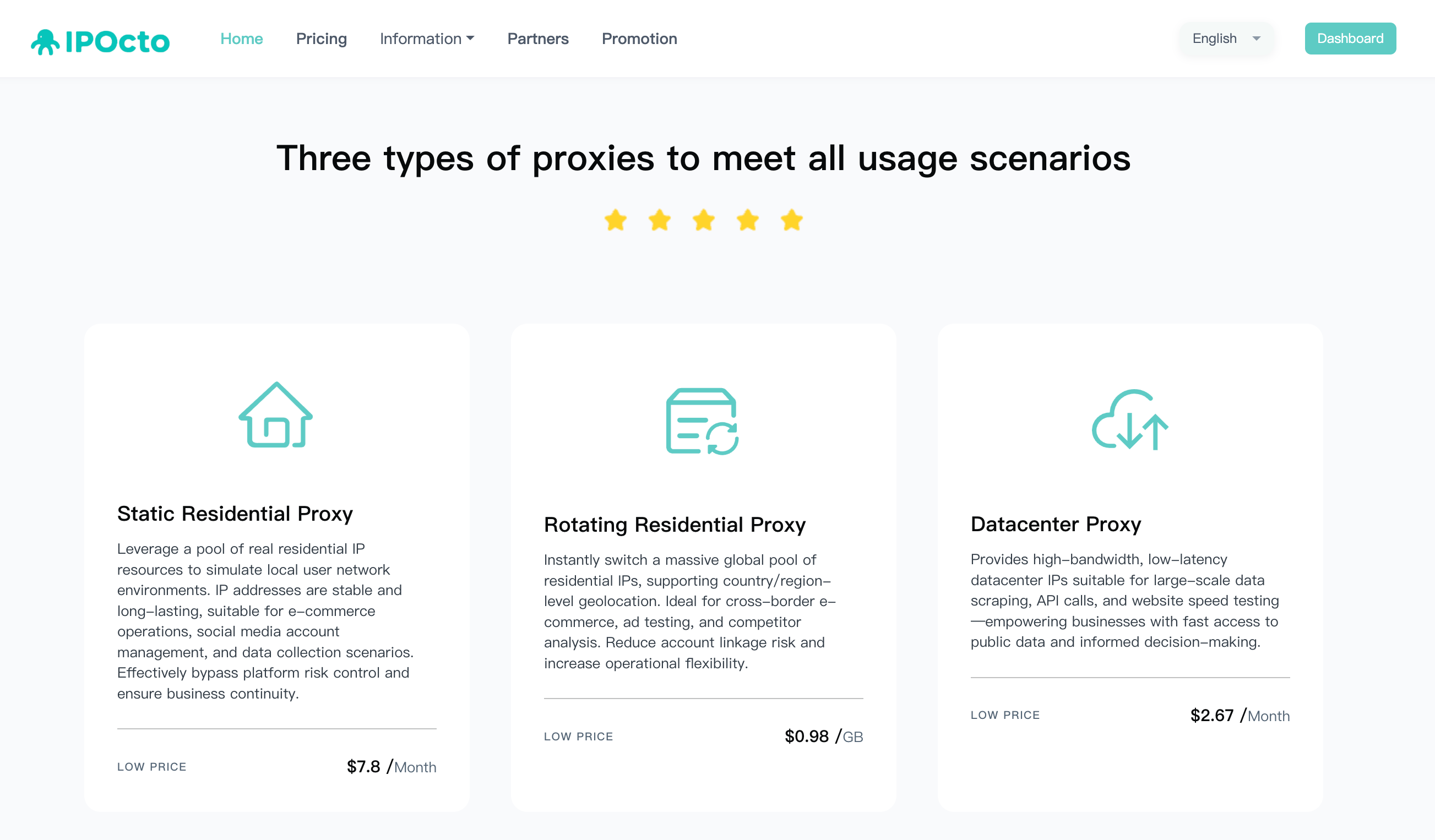
In the service practices of IPocto, through extensive communication with numerous users, we have found that successful operators never expect one proxy to solve all problems. Instead, they treat it like assembling a toolbox, selecting the most suitable tools for different tasks.
- Dynamic Residential Proxies: Your "Registration and Crawler" Weapon
- Essence: The IP pool comes from real home broadband users. IP addresses change on demand or at scheduled intervals, with geographically dispersed locations.
- Social Media Scenarios: Most suitable for batch registration of accounts in their initial stage and large-scale social media data scraping (e.g., crawling public posts, tag data). It can maximally simulate the natural registration behavior of real users from different regions worldwide, effectively diluting registration risks.
- Notes: Due to their dynamic nature, they are not suitable for daily maintenance of accounts requiring long-term stable logins, as frequent IP jumps can trigger risk controls.
- Static Residential Proxies: Your "Account Nanny" and "Stable Identity"
- Essence: Also from real residential network IPs, but the key difference is that this IP address is permanently fixed to you.
- Social Media Scenarios: This is the gold standard for daily account operations. Imagine a user in New York logging into Facebook for a long time through an IP from the same ISP; this is the most natural behavior. Static residential proxies provide this "stable digital residence permit," making them ideal for long-term nurturing of core accounts, content publishing, advertising management, and customer communication.
- Core Value: Provides the highest level of security and credibility, forming the cornerstone of preventing mature accounts from being banned due to abnormal network environments.
- Data Center Proxies: Focus on "Efficiency," but Must Be Isolated from "Account Operations"
- Essence: IPs come from data center servers, offering fast speeds, low costs, and strong concurrency capabilities.
- Social Media Scenarios: Never directly used for logging into or operating any valuable social media accounts. Their stage is for high-speed, high-concurrency public data collection, price monitoring, SEO ranking tracking, and other tasks. You can use them to quickly browse competitor homepages (without logging in) or scrape public information, but the risk is extremely high once account logins are involved.
Practical Workflow: A Safe and Efficient Social Media Operations Cycle
Let's follow the case of a cross-border e-commerce team, Team A, to see how they combine their usage:
- Market Entry Stage (Registration): Team A planned to promote new products in Germany. They used IPocto's dynamic residential proxies to register a batch of new social media accounts from Germany's residential IP pool in various cities, maintaining a reasonable time interval. Each account acquired a clean, independent initial network fingerprint.
- Nurturing and Cultivation Period (Maintenance): After new accounts were registered, they assigned a German static residential proxy to each core account. Over the next 2-4 weeks, these accounts engaged in low-intensity activities (completing profiles, browsing content, occasional likes) through this fixed IP, gradually cultivating the account's "natural weight" and stability.
- Mature Stage Operations (Daily Publishing and Advertising): Once accounts matured, the team continued to use their respective static residential proxies for daily content publishing, advertising, and customer interaction. The long-term stability of the IP ensured account security.
- Market Monitoring (Data Collection): Simultaneously, the team used IPocto's data center proxies to rapidly scrape price information from major German e-commerce platforms and public social media dynamics of competitors, providing data support for their marketing strategies. The entire process was completely isolated from the IP network used for operating accounts.
The core of this workflow is "separation of dynamic and static, dedicated lines for dedicated purposes." Dynamic IPs are used for initial stages requiring "volume" and "change," static IPs for asset maintenance requiring "stability" and "longevity," and data center IPs for pure data tasks. Through the diverse proxy packages offered by IPocto, teams can flexibly configure resources, maximizing security and efficiency while controlling costs.
Conclusion
The security of social media accounts is a continuous, refined battle with platform risk control systems. The key to rejecting associated account bans lies not in finding a "universal" solution, but in establishing a "matching" mindset. Deeply understanding the real needs of network identity for each link in your operational chain, and matching it with the most suitable proxy type, is the first step in building an account security firewall.
This means shifting from a crude approach of "having an IP to use" to a refined one of "using the right IP for the right job." Whether you need a large volume of dispersed IPs for initial deployment, stable identities for long-term asset maintenance, or high-speed resources for market insights, choosing a platform like IPocto that provides clear, clean, and clearly categorized proxy services is itself a manifestation of professional risk management. After all, in the digital world, your IP is one of your most important identity credentials, deserving of the most suitable "safe box," just like your physical assets.
Frequently Asked Questions FAQ
Q1: I already have a banned account. Will registering a new account with a new proxy still be associated? A: The risk is high. In addition to IP, platforms also associate accounts through device fingerprints (e.g., browser, hardware information), registration information (email, phone number, profile), etc. Without clearing all associated traces (using a completely new environment and information), simply changing the IP is insufficient to guarantee safety. It is recommended to use dynamic residential proxies combined with a completely new environment for registration.
Q2: Between static residential proxies and dynamic residential proxies, which is safer? A: Safety is relative and depends on the scenario. For daily operations of accounts that need to exist long-term and stably, static residential proxies are safer because they simulate the fixed internet usage habits of real users. For registration or data scraping, dynamic residential proxies are safer because they offer a high degree of anonymity and dispersion. Both are high-quality residential IPs; the core difference lies in "fixed" versus "changing."
Q3: I only manage my accounts occasionally. Do I need such stable IPs as static residential proxies? A: If your accounts have high value (e.g., accumulated a large number of followers or order history), even if your operations are infrequent, it is strongly recommended to use static residential proxies. A drastic IP change (e.g., jumping from an American data center IP to a British residential IP) during occasional logins is itself a high-risk behavior. A fixed, real residential IP can provide the most basic stability guarantee for your valuable accounts.
Q4: How can I judge the quality of IPs provided by a proxy service provider? A: You can focus on a few points: 1) IP Source: Is it clearly marked as residential ISP (e.g., Comcast, Deutsche Telekom, etc.)? 2) Cleanliness: Has the IP been widely used by social media platforms (you can request a test or check reviews)? 3) Service Transparency: Does the provider clearly distinguish proxy types and provide application recommendations? For example, in IPocto's packages, the purpose of different proxy types will be clearly indicated to help users avoid misuse risks.
📤 Share This Article
🎯 Ready to Get Started?
Join thousands of marketers - start boosting your Facebook marketing today
🚀 Get Started Now - Free Tips Available