Goodbye Account Association: How to Achieve Precise Matching Between Proxy IPs and Facebook Account Environments?
In the fields of cross-border e-commerce and overseas marketing, Facebook accounts are invaluable assets for connecting with global customers. However, many marketing teams and advertising agencies face a common nightmare: accounts being banned in bulk due to association. You may have invested significant effort in account nurturing and ad optimization, only to see all your work undone by a seemingly minor detail – the match between your proxy IP and account environment. Today, we will delve into the core of this issue and share a professional approach to achieving "proxy-account" zero-error matching.
Why are Your Facebook Accounts Always "Running Naked"?
Imagine managing dozens, even hundreds, of Facebook accounts for different clients, regions, or marketing campaigns. For security, you've been using proxy IPs, believing you're safe. But the reality is, the alarm bells for account bans still ring frequently. The root cause often lies not in the proxies themselves, but in "environmental" inconsistencies.
Facebook's risk control system is extremely complex; it doesn't just check your IP address. It builds a "digital fingerprint" including a series of parameters like your browser cookies, cache, timezone, language, WebRTC, Canvas fingerprint, and more. When you use the same proxy IP pool for multiple accounts, but each account's browser environment differs significantly, to Facebook, it's like the same person appearing repeatedly in different outfits, drastically increasing the risk of association. The degree of matching between proxy IPs and account environments is the first, and most often overlooked, defense line against account association.
The Pitfalls of Manual Management: Efficiency and Security Are Hard to Achieve
When facing multi-account management, traditional methods typically involve: using multiple virtual machines or VPS, relying on browser multi-tab plugins, or manually switching proxies. These methods, while seemingly direct, hide significant limitations and risks:
- Low efficiency: Manually configuring independent proxy IPs and browser environments for each account is time-consuming, labor-intensive, and prone to errors. When collaborating in a team, configuration chaos is the norm.
- Environmental pollution: Incomplete clearing of browser cache and cookies can lead to information leakage between different accounts, forming "soft associations."
- Chaotic proxy management: Manually recording and allocating proxy IPs can easily lead to reuse or configuration errors, directly resulting in IPs being flagged.
- Lack of scalability: When the number of accounts grows to hundreds, the manual management model completely collapses, and operating costs rise exponentially.
These methods are essentially "patching" problems rather than solving them at a systemic level. They tie up the administrator's energy in tedious operations instead of core marketing strategies.
From "Isolation" to "Matching": Building Secure Underlying Logic
A more rational solution should start from the underlying logic, treating each Facebook account as a completely independent and stable virtual digital identity that needs to be built. The construction of this identity requires the precise synergy of two core elements:
- A clean and stable proxy network: Proxy IPs need to possess high anonymity, purity (not being abused), and ideally offer residential or datacenter IPs matched to the target region.
- An independent and isolated browser environment: Each account must run in a physically isolated browser environment, possessing exclusive cookies, local storage, fingerprint information, and environment parameters (such as timezone, language) that align with the proxy IP's geographic location.
Only when these two elements achieve automated, one-to-one precise matching can the threads of association between accounts be cut off at the source. This means we need a system capable of intelligently binding high-quality proxy resources with independent browser environments.
The Power of Integration: How FBMM and IPocto Achieve "Proxy-Account" Zero-Error Matching
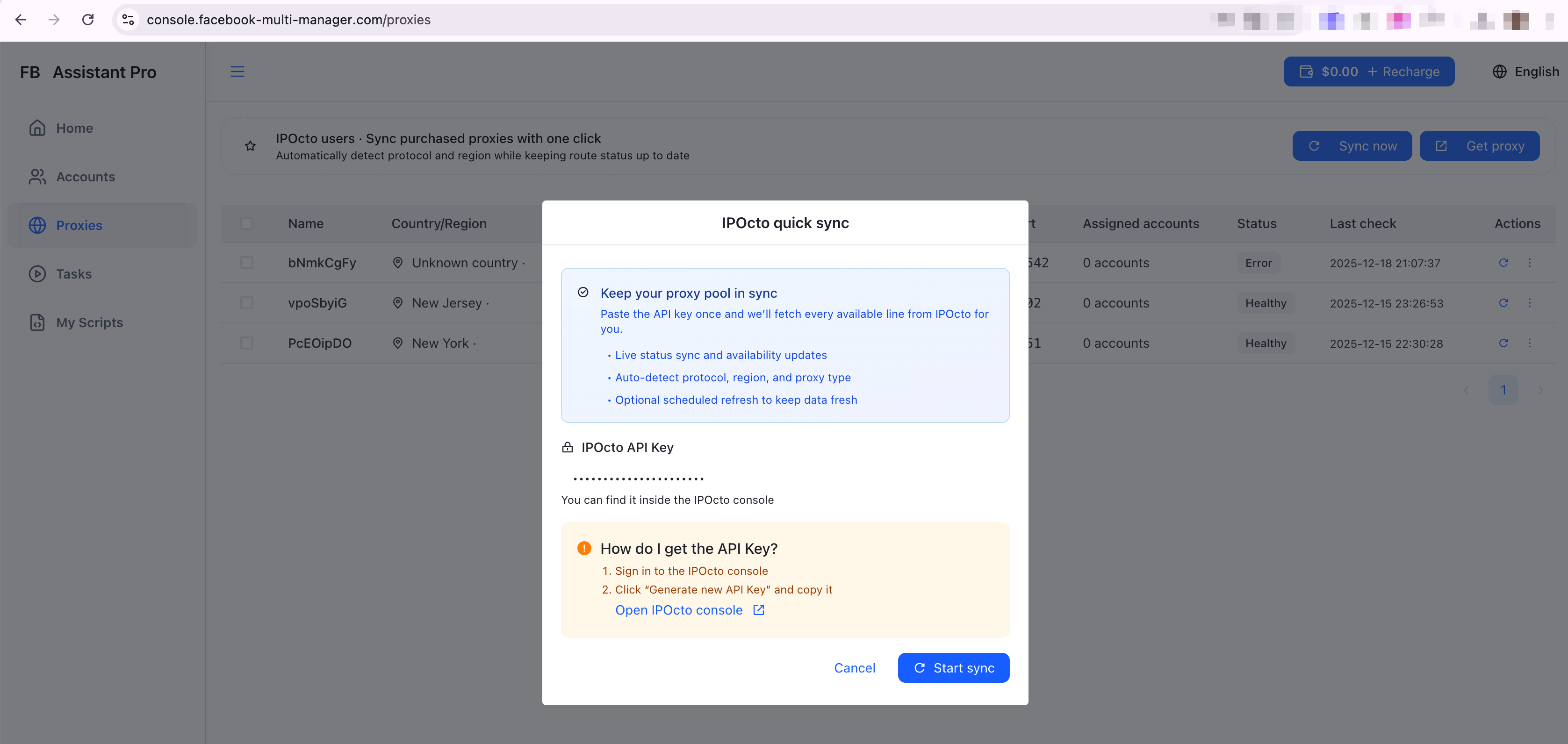
In practice, implementing the above approach requires a solution capable of seamlessly integrating proxy services with multi-account management platforms. This is precisely where professional tools add value. Taking platforms like FBMM (Facebook Multi Manager) as an example, when deeply integrated with professional proxy services (like IPocto), they can build an efficient and secure automated workflow.
Its core value lies in automated synchronization and precise configuration:
- One-click synchronization, goodbye to manual input: Users no longer need to switch back and forth between multiple platforms to copy and paste IP addresses and ports. FBMM can directly synchronize the high-quality proxy list provided by IPocto, fundamentally eliminating the risks of manual input errors, chaotic formatting, or duplicate IP allocation.
- "Account-Proxy-Environment" triple binding: Each Facebook account, when created or allocated, is permanently or long-term bound to a specific proxy IP and an independent browser environment. This binding relationship is automatically maintained by the system, ensuring the traceability and security of operations.
Through this deep integration, managers no longer need to focus on complicated proxy configurations and environment settings, but rather on the account's marketing performance itself. Security and efficiency, once opposing forces, become a unified whole.
A Cross-Border E-commerce Team's Daily Workflow Transformation
Let's look at a scenario to see how this integrated solution transforms real work:
Past (Manual Management Stage): In the morning, operations specialist Xiao Zhang opens a spreadsheet to find the proxy IPs corresponding to the 10 accounts that need to publish products today. He opens different browser profiles one by one and manually sets up the proxies. During the process, he accidentally enters the proxy for Account A into Account B's configuration. In the afternoon, both accounts receive security verification at the same time. In the evening, the team needs to send promotional messages to 100 existing client accounts, and Xiao Zhang and his colleagues work overtime until late at night, repeating the mechanical switching and sending operations.
Now (After Using the Integrated Solution): Xiao Zhang imports 100 clean residential IPs provided by IPocto into the FBMM platform in one go. Through simple rule settings (e.g., allocation by country, business line), the system automatically matches these 100 IPs with 100 independent browser environments and creates 100 Facebook account operating windows. When needing to batch publish products, he simply edits a post in FBMM's Batch Control center, selects the target account group, and completes publishing with one click. Sending client messages, liking, and commenting tasks can also be completed in a batch automated manner. Xiao Zhang saves over 12 hours per week, allowing him to focus on analyzing ad data and optimizing marketing strategies. More importantly, the survival rate of the team's accounts has significantly increased, with bans due to environmental issues being almost zero.
| Comparison Dimension | Traditional Manual Management | FBMM & IPocto Integrated Solution |
|---|---|---|
| Proxy Configuration Efficiency | Extremely low, prone to errors | One-click synchronization, zero errors |
| Environment Isolation | Poor, relies on manual cleaning | Physical level isolation, automatic matching |
| Scalability | Difficult to exceed 50 accounts | Easily manages thousands of accounts |
| Team Collaboration Efficiency | Chaotic configuration, unclear responsibilities | Clear permissions, traceable operations |
| Core Risk | Human error leading to association | System automation guarantees security |
Conclusion
In the "security game" of Facebook multi-account operations, victory does not belong to those with the most proxy IPs, but to the team that can achieve the most precise environmental matching. Deeply integrating high-quality proxy resources (like IPocto) with professional multi-account management platforms (like FBMM) to build an automated "proxy-account-environment" matching workflow is a crucial step from passive defense to active security.
This is not just an upgrade of tools, but an evolution of management thinking. It liberates marketers from tedious technical operations, allowing them to truly return to core value-creating work such as content creation, customer interaction, and data analysis. Under the premise of compliance, safely and efficiently expand your digital influence.
Frequently Asked Questions (FAQ)
Q1: I'm already using proxy IPs, why are my Facebook accounts still getting blocked for association? A1: Using proxy IPs alone is just the foundation. Facebook's risk control system detects multiple signals, including browser fingerprints, cookies, and behavioral patterns. If your multiple accounts share similar browser environments (even with different IPs), or if the proxy IPs themselves are not clean or are shared by many users, it will lead to association. The key is to achieve precise, one-to-one matching between proxy IPs and completely independent browser environments.
Q2: For small to medium-sized teams managing multiple Facebook accounts, what is the most critical risk to be aware of? A2: Besides obvious violations (like posting prohibited content), environmental cross-contamination and identical operation behavior patterns are two major hidden killers. Avoid frequently switching and logging into different accounts on the same computer with the same browser. It is recommended to use professional tools that provide environment isolation and batch automation capabilities, establishing an independent, compliant "digital identity" for each account from the beginning, and ensuring daily operations (such as posting, interacting) adhere to normal user behavior rhythms.
Q3: How can I determine if a multi-account management tool is truly secure? A3: Pay attention to a few key aspects: 1. Environment Isolation Technology: Does it use virtual machine-level or advanced fingerprint browser-level true isolation? 2. Proxy Integration Capability: Does it support convenient access to high-quality proxy services and achieve automatic matching? 3. Behavior Simulation Logic: Does the batch operation function support random delays and human-like operation simulation to avoid mechanical behavior? 4. Team Permission Management: Does it have clear account allocation and operation log auditing functions? A professional platform like FBMM that focuses on the Facebook ecosystem and continuously updates its anti-risk control strategies is usually a more reliable choice.
📤 Share This Article
🎯 Ready to Get Started?
Join thousands of marketers - start boosting your Facebook marketing today
🚀 Get Started Now - Free Tips Available